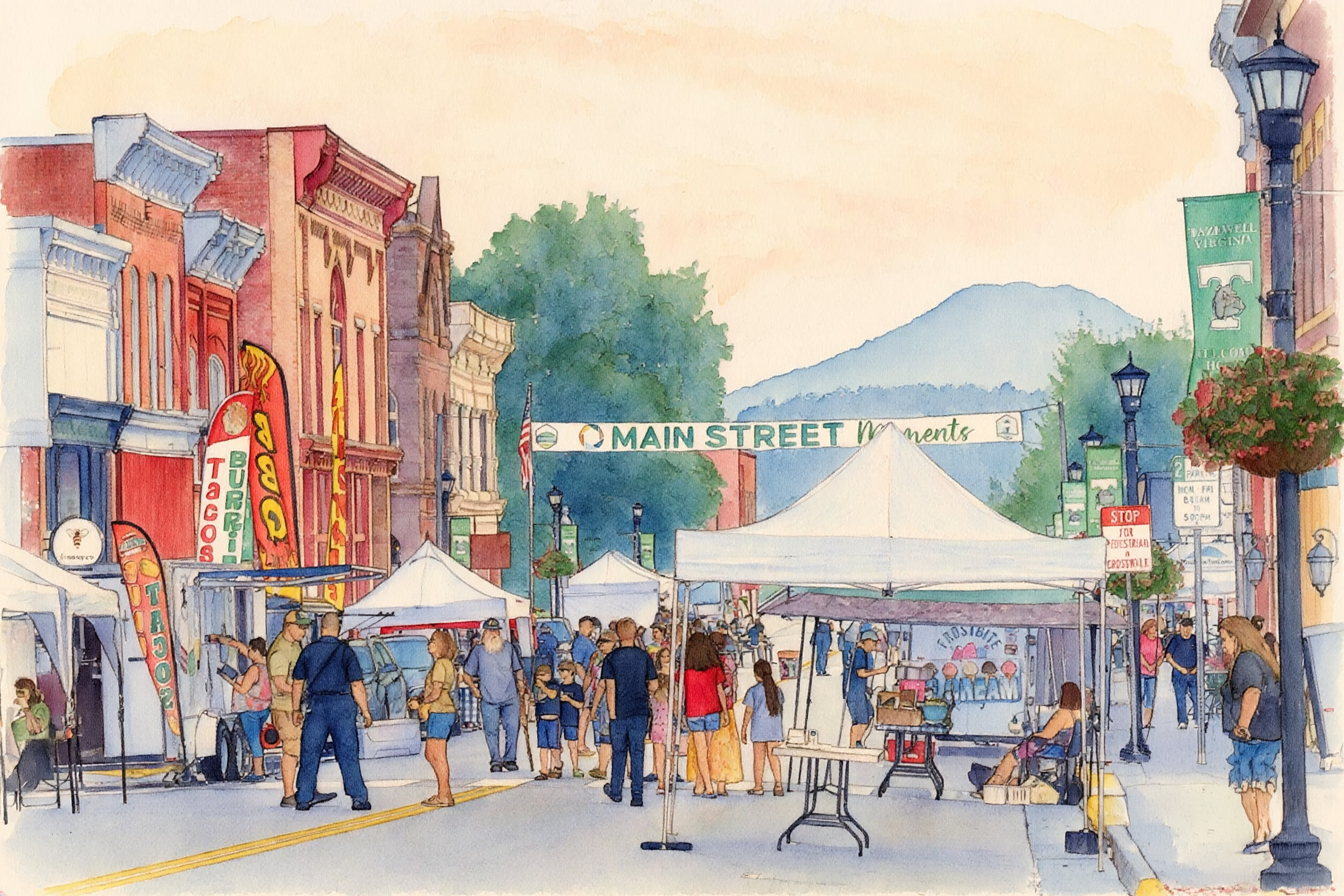
I have been trying to trace the beginning of Main Street Moments, and the history is not as easy to find as it should be. What remains is scattered through old newspaper pages, photographs, festival programs, and the memories of people who were there. I believe that is where the real story still lives, because most community traditions are not built by the people whose names eventually appear on banners. They are built by the ones who make the calls, carry the tables, invite the musicians, hang the signs, find the extension cords, sweep the sidewalks, and stay after everyone else has gone home.
What I keep coming back to is that Main Street Moments appears to have started with a much deeper purpose than simply giving people something to do for a weekend.
The early festival was rooted in art, music, literature, history, and the idea of a community homecoming. That tells us something important about the people who first imagined it. They believed Tazewell already had something worth celebrating. They did not need to invent an identity for the town. They wanted to gather the identity that was already here and place it in the middle of Main Street.
A town is never only its buildings. It is also the songs people know by heart, the stories families repeat, the photographs kept in drawers, the work made by hand, and the memories attached to places that may look ordinary to everyone else.
Main Street Moments gave those things a place to meet.
For a few hours, the street became more than a road through town. The buildings became part of the setting. Storefronts opened. Music moved between the brick walls. People stopped where they would normally drive through. Someone who had moved away could come home and stand beside someone who had never left.
That may be why the old description of the festival as a community homecoming feels so right.
A homecoming is not merely entertainment. It is recognition. It is seeing a familiar face in a crowd, hearing a song that belongs to another time, or looking down a street you have known all your life and seeing it differently for a moment.
There is something especially Appalachian about building an event around art, music, stories, and history. Much of our history has never lived in formal archives. It has survived in church songs, local newspapers, family photographs, quilts, recipes, front porch conversations, and stories that were passed down because someone cared enough to remember them.
Main Street Moments seems to have understood that.
The arts were not there simply to fill the schedule. They were part of the meaning of the event. Music, writing, craft, history, and community life were placed together because they belonged together.
Over time, traditions change. Committees turn over. Businesses open and close. The people who did the early work grow older, and some of their names begin to disappear from the story. That is why it matters to ask who first imagined Main Street Moments, who gave it its name, who brought in the artists and musicians, who convinced businesses to participate, and who kept it alive during the years when there may not have been much attention or support.
Those people are part of the history of the event, whether their names remain on the record or not.
I do not think Main Street Moments began because Tazewell needed another festival. I think it began because someone understood that this town had stories, talent, memory, and character worth bringing into public view.
That is a different thing.
The tents will come down. The music will stop. The street will reopen. By the next week, most of the signs will be gone.
But someone may remember dancing in the street. Someone may walk into a building they had passed for years. Someone may hear a local musician and discover a voice they did not know was here. Someone may see an old photograph and recognize a name they had almost forgotten.
Those moments are small, but towns are built from small things remembered together.
Perhaps that is what Main Street Moments was always meant to be: not simply an event on the calendar, but a place where Tazewell could gather long enough to recognize itself.